

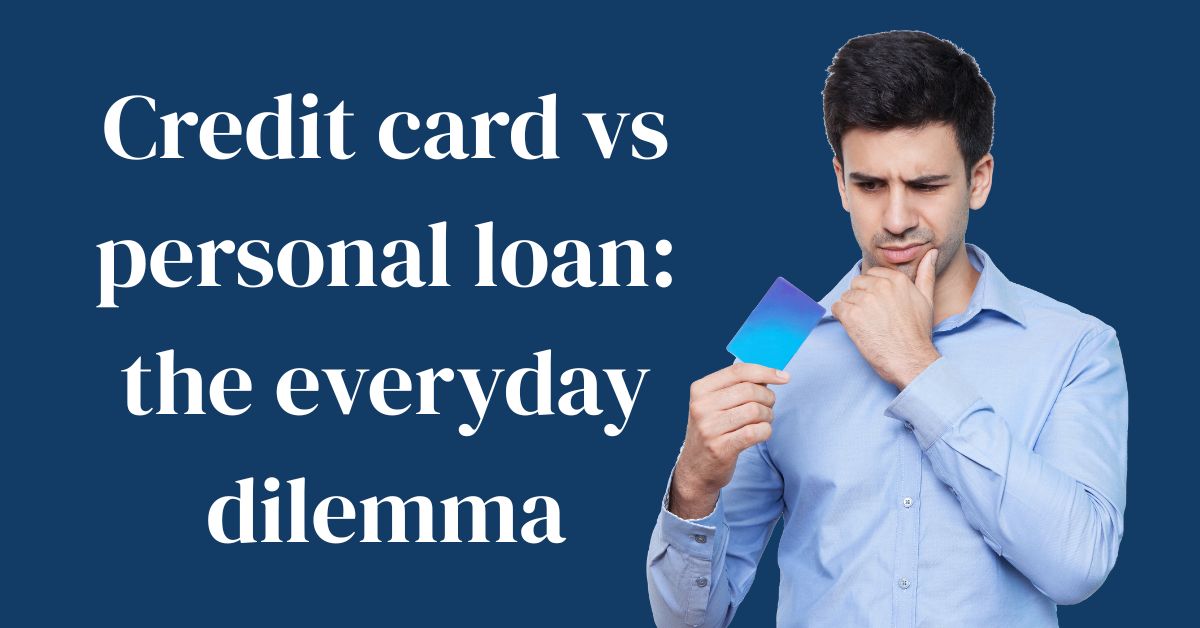
Credit card vs personal loan: the everyday dilemma
If you live in India today, you know this scene well: mid-month money is tight, an expense pops up suddenly, and the question hits you—“Should I swipe my credit card or take a personal loan?” This is not just a math problem; it’s a life decision that affects your peace of mind, your monthly budget, and your future borrowing power.
The blog demystifies credit cards and personal loans in real, understandable terms: how they work, where they shine, where they trap you, and practical scenarios to help you decide which one is best for any given real-life situation.
What is a credit card, really?
A credit card basically is a short-term loan in your pocket. As opposed to paying from your bank balance, the bank pays on your behalf, and then you clear the bill later.
Key features:
- You get a “credit limit” depending upon your income and credit score – say ₹ 50,000 or ₹ 1,00,000.
- You get an interest‑free period for new purchases, which generally ranges from 45 to 50 days if you pay the bill in full on time.
- Unless you pay the full amount, the amount remaining starts accruing high interest.
Think of it as: convenient, flexible, powerful—but dangerous if misused.
What is a personal loan?
A personal loan is the lump-sum amount one borrows from a bank, NBFC, or fintech app and returns in fixed EMIs over a set tenure, say 12, 36, or 60 months. It is generally unsecured, which means no collateral in the form of gold or property is required.
Key features:
- You get a one‑time amount, say ₹2 lakh, credited directly to your account.
- You pay back in fixed EMIs over a fixed period at a fixed rate of interest.
- The rate of interest is usually lower than credit card interest but higher than that of secured loans, like home loans.
Think of it as structured, predictable, and better for bigger, planned expenses.
How interest works-the heart of the decision:
You don’t have to be a finance nerd to choose smartly, but you need to understand the basic difference in how interest works.
Credit card interest:
- If you pay your full credit card bill by the due date every month, then you generally pay zero interest on new purchases.
- If you pay only the minimum amount, for instance, 5% of the bill, then the outstanding balance attracts interest often at rates of 30–40% per annum or more.
- Interest is normally charged on the daily outstanding balance, and therefore, rolling your dues for months together can be very costly.
Personal loan interest:
- Personal loans generally have a fixed interest rate, such as 11-24% per year, depending on your profile.
- Your EMI remains more or less constant; hence, you know exactly how much is going out every month.
- You can’t be “revolved” like a card; you must pay EMIs on a timely basis, else you will attract penalties and your credit score will fall.
Thumb rule:
- If you can clear the credit card bill in full, use the card.
- If you need a larger amount and will repay over many months or years, a personal loan is usually safer and cheaper.
Benefits of credit cards to Indian users
When used appropriately, credit cards can actually enhance one’s financial life.
Some everyday benefits:
- An interest-free period allows you to purchase a product and not pay for it for several weeks without incurring any fees, provided that you pay your bill in full by the due date.
- Many cards in India also provide rewards and/or cashback for using the card to pay for groceries, shopping online, and paying utility bills, as well as for use of the card as a transportation mode.
- You will also have greater convenience and safety when making online purchases, as there will be less need to carry heavy amounts of cash with you, and if you lose or misuse the card, you can easily block it and have some insurance coverage against any unauthorised transactions.
- Some companies offer “No-Cost EMI” options for customers who want to make large purchases using the card, such as a new cell phone, TV, or laptop. Some of these offers may require you to make your purchase from specific brands or retailers.
- Building credit score: Regular use in conjunction with on‑time full payments will help build a strong credit history, making it easier to get bigger loans later on.
In short, A credit card is great for day‑to‑day transactions, emergencies, and earning benefits—if you are disciplined.
Drawbacks and risks of credit cards
Many of the same features that make credit cards so attractive can also turn them into a trap if one is not careful.
Common risks:
- Overspending: Because money doesn’t leave your bank account immediately, it is easy to swipe without feeling the pain. You only “feel” it when the bill comes.
- High interest rates: once you start rolling over balances, interest can snowball quickly; a few months of dues that remain unpaid can turn into a heavy burden.
- Minimum payment illusion: Paying only the minimum due looks harmless, but it keeps you in debt for a very long time and costs you a lot in interest.
- Hidden fees and charges include annual fees, late payment charges, over‑limit fees, cash withdrawal charges, and GST that add up discreetly.
- The damage to the credit score: Repeated late payments, maxing out the card limit, and high utilisation result in lowering the credit score.
Reality check:
Remember, a credit card is not free money. It’s a tool that works for you only if you control it, not the other way around.
Benefits of personal loans for Indian borrowers
Personal loans, especially from banks and reputed NBFCs, can be a healthier option for bigger, planned expenses.
Major advantages:
- Larger quantum: Depending on your profile, you can get amounts from approximately ₹50,000 to ₹20 lakh or even more.
- Structured repayment: Fixed EMIs help you plan your monthly budget. You know exactly when the loan will end.
- Lower interest than card debt: The rates on a personal loan are generally much lower than those on rolling credit card balances.
- No collateral: You generally don’t need to pledge gold or property, making it accessible for salaried people.
- Debt Consolidation: You can consolidate multiple high-interest debts, such as many credit cards, into one loan with a lower interest rate and a single EMI.
This makes personal loans suitable for big events or expenses that are predictable and long‑term.
Drawbacks and risks of personal loans
Personal loans are not “soft” loans; they are serious commitments.
Possible downsides:
- EMI burden: You are locked into a fixed monthly payment. If your income becomes unstable, EMIs can become stressful.
- Processing fees and charges: There are processing charges, documentation charges, and penalties levied against late payment or pre-closure.
- Longer debt commitment: A 4–5-year loan means that part of your income is blocked every month for years to come.
- Overborrowing temptation: Easy instant loan apps can drive you to take more than you actually need, just because the approval is fast.
The key is to borrow just that amount, which is necessary, and always consider the EMI impact on your monthly cash flow.
When a credit card makes more sense
Let’s bring this into real life. Here are some situations where a credit card is usually the better choice.
Use a credit card when:
- The expense is small or medium: groceries, fuel, eating out, subscriptions, or monthly online shopping.
- You can pay in full next month: Say your salary is due soon, and you just need a short‑term bridge.
- You want rewards or cashback: flights, hotel bookings, or large e‑commerce sales where your card offers strong benefits.
- You have a genuine emergency: Sudden medical expense, urgent last‑minute travel, etc., where you need instant payment.
- You want to build your credit history: Small regular spends + full repayment is a great way to build your score.
Example:
You purchase a ₹10,000 mixer or smartphone on your credit card during a sale and know that you will be able to pay the entire ₹10,000 when the bill comes. A card is perfect here: you enjoy an interest‑free period plus any cashback or discount.
When a personal loan makes more sense
Now, consider cases where a personal loan is generally the smarter option.
Use a personal loan when:
- The cost is high and one‑time:
- Wedding expenses
- Major home repairs or renovation
- Higher education costs
- Large medical bills are not fully covered by insurance.
- You need a longer repayment period: You know you cannot clear the amount in one or two billing cycles and need 1–5 years.
- You’re consolidating debt: You are juggling multiple credit card bills already and want a single lower-interest EMI to clean it up.
- You want predictable outgo: You prefer fixed EMIs over variable credit card dues, so budgeting is easier.
Example:
You are planning a wedding and are expecting expenses of ₹5 lakh. Your credit card limit is ₹1.5 lakh, and revolving that much will be too expensive. A personal loan of ₹5 lakh with a manageable EMI over 3–5 years is generally more sensible.
Comparison of Credit Cards vs. Personal Loans at a Glance
Here’s an easy way to see the differences in your head, without a technical table:
Purpose:
- Credit card: Everyday spending, regular transactions, short‑term borrowing.
- Personal loan: Large, planned, or unavoidable one‑time expenses.
Quantity:
- Credit card: Limited by your credit limit, which is usually lower than what you can get via a loan.
- Personal Loan: Higher ticket sizes available based on your income and credit profile.
Interest:
- Credit card: Very high if you don’t pay in full; zero if you clear in time.
- Personal loan: Moderate but fixed. Usually cheaper than rolling card dues.
Flexibility:
- Credit Card: Highly flexible; you borrow and repay as per usage.
- Personal loan: fixed structure, less flexibility, but more discipline.
Risk:
- Credit card: High risk of debt trap if you overspend and revolve.
- Personal loan: EMI pressure, but more controlled, if borrowed responsibly.
Typical Indian scenarios and smart choices
Let’s walk through some common situations that an Indian household might face, and which option tends to fit better.
Scenario: A new smartphone or laptop.
- You want to buy a ₹25,000 phone during a festive sale.
- You can comfortably pay it off in one or two months.
Better option: Credit card, particularly if there is:
- No‑cost EMI
- Cashback or instant discount. Just make sure you don’t let that EMI drag on for too long or start multiple EMIs at the same time.
Scenario: Medical emergency
- A sudden hospitalisation requires ₹ 80,000-₹2 lakh immediately.
- You don’t have that much in savings.
Better option:
- If you have a high credit-limit card, then you may use it immediately to pay the hospital.
- However, for repayment over many months, converting that hospital bill into a personal loan or card EMI at a reasonable rate is better than just revolving card dues at high interest. Often, a mix is applied: card for immediate access, then loan to manage repayment.
Scenario: Marriage or big family function
- You’re planning a function with expenses around ₹3–6 lakh.
- You need clarity on EMIs so that your household budget does not collapse.
Better option: Personal loan.
A well-planned loan works better than swiping multiple cards, hitting limits, and then struggling with minimum payments.
Scenario: House makeover
- You intend to spend ₹1–2 lakh on painting, furniture, and minor construction.
- The work is planned and not urgent.
Better option:
- Personal loan if you want a longer tenure and stability.
- Alternatively, use your card only for parts where you will repay within 1–2 cycles and the rest via a loan.
Scenario: Managing multiple credit cards.
- You already have 2–3 cards with rolled‑over balances.
- Every month, you pay only the minimum dues and feel stuck.
Better option: personal loan for debt consolidation.
It lowers overall interest cost and reduces stress if you take one loan at a lower interest rate and pay off all card dues in one shot, provided you then use cards more responsibly.
How to decide: a simple 5-question checklist
Before you choose between a credit card and a personal loan, take a moment to ask yourself these five questions.
How large is the expense?
- If it’s small/medium and fits within your card limit comfortably, it is usually fine, along with your capacity for next month’s repayment.
- If it’s large and will take many months or years to repay, a personal loan is usually better.
Can you pay the whole bill on the card next month?
- If yes, then use the card and enjoy the interest-free credit.
- If not, give serious consideration to a personal loan instead.
How long will you take to repay?
- Short‑term (1–2 billing cycles): Credit card works.
- Medium to long‑term (6 months–5 years): a personal loan is safer and more predictable.
What will this do to your monthly budget?
- A large new EMI can stretch your finances; try to keep total EMIs (including existing loans) preferably below 30–40% of your net monthly income.
- Huge, unpredictable card bills can be even more stressful than a fixed EMI.
Are you disciplined with money?
- If you tend to spend impulsively, it can be risky to use credit cards heavily.
- A personal loan forces discipline because EMI is non‑negotiable.
Practical tips to avoid falling into debt traps
Whatever route you take, there are some simple habits that will safeguard your financial health.
For credit cards:
- Consider this card limit as a maximum danger zone, not as extra money.
- Try to keep utilisation below approximately one‑third of your limit.
- Pay the full amount due each month, never just the minimum amount.
- Avoid withdrawing cash using a credit card unless it’s a life‑or‑death emergency; it’s usually expensive.
- Don’t hold too many cards just for offers – one or two well‑chosen cards are enough for most people.
Personal Loans
- Borrow only what you really need, not the most that the lender is willing to lend.
- Opt for the shortest tenure you can comfortably afford because the longer tenure means more total interest.
- Read all the terms: prepayment charges, late fees, etc.
- Avoid stacking multiple personal loans from different apps, just because the approval is quick; that’s a surefire way to enter a debt spiral.
So, credit card or personal loan?
There is no blanket “best” option. Smarter choices depend on: The size of your expense, how soon you are able to repay, your current debt situation, and your spending and repayment discipline.
A good rule of thumb for your Indian audience:
- Credit card: It is like a sharp knife-great when wielded by skilled hands, dangerous if careless. Perfect for short‑term, manageable expenses that you can clear quickly.
- Personal loan: Use it like a long‑term commitment—think carefully before signing, but rely on it for big, planned needs where structured EMIs protect you from chaos.
If one keeps his or her lifestyle a little below one’s income, uses a credit card thoughtfully, and resorts to personal loans only for big and important decisions, then both tools could support financial growth rather than becoming financial handcuffs.






Leave a Reply