

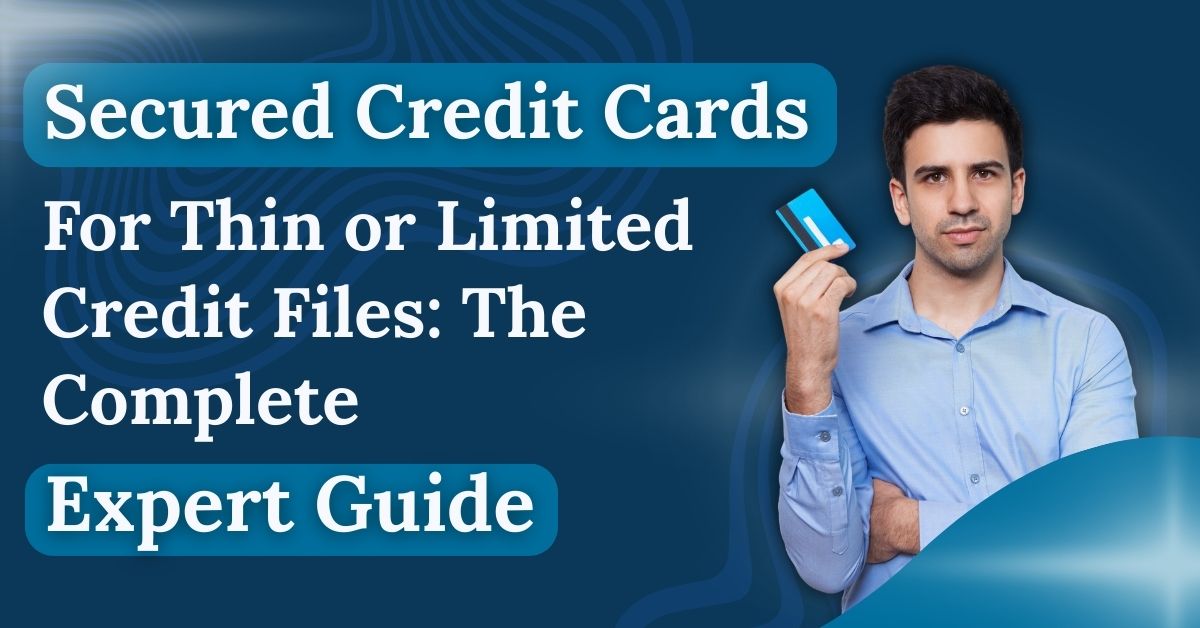
Secured Credit Cards for Thin or Limited Credit Files: The Complete Expert Guide
Thinking about building or fixing your credit? Secured credit cards are a pretty good way to go, especially if you’re just starting out. I will tell you what they are, why they’re good if you don’t have much credit, what you need to get one, the good and bad sides, how to use them the right way, and how they might change your credit score. Also, I’ve put in some stories about people who’ve used them and a plan to help you begin.
What is a secured credit card?
In contrast, a secured credit card requires you to deposit collateral, typically cash, with the card issuer as security. That deposit becomes your credit line or a big part of it. You deposit ₹20,000, for instance, and the issuer gives you a card with a ₹20,000 credit limit. Since the bank may recover losses from your deposit, secured cards are less risky for the issuers and hence available to applicants with no, thin, or poor credit histories.
Key Characteristics:
- Cash security deposit held in a lien or fixed deposit with the bank/ NBFC.
- Usage of the card is the same as a regular credit card: purchases, billing cycle, minimum payment, and interest if you carry a balance.
- Actually, after you’ve shown you can handle a secured card responsibly for a while, many companies will switch you to a regular, unsecured card and give you back your deposit (or remove the claim on it).
- These companies also report your activity to credit bureaus, which helps you build up your credit history.
Why secured cards are ideal for thin-file borrowers
- Easier approval: Because of collateral, issuers approve applicants that otherwise would be rejected for unsecured cards.
- Controlled exposure: This deposit limits both your credit line as well as the issuer’s risk; it is thus the conservative path to credit.
- Safe way to learn: You can practice on-time payments and disciplined utilization without large exposure.
- Develops credit history: Since the issuers report to credit bureaus, making timely payments and low utilization helps in building a good score trail.
- Path to unsecured credit: Good behavior normally leads to the upgrade of a regular credit card and release of the deposit.
Typical benefits of secured credit cards
- Access to credit while building one’s credit history. Secured cards are a launching pad for students, new-to-country workers, early-career professionals, and those rebuilding from past credit missteps.
- Lower friction to approval and faster issuance. Some issuers approve and then issue cards in a few days to weeks once the deposit is received.
- Convertibility to unsecured card: Many banks offer an automatic review and upgrade after 6–12 months of responsible usage.
- A financial education opportunity: Learn about billing cycles, due dates, the rewards structure, and how to avoid interest by paying in full.
- Possibly lower fees or personalized packages. A few secured products are very basic, offering super-low fees; thus, this makes them rather affordable credit-building tools.
Typical Approval Criteria: What the Banks look for
Secured cards lower the bar, but the issuers still check the following items:
- Proof of identity and address: Passport, Aadhaar, voter ID, driving licence, utility bills — the standard KYC.
- Proof of income, sometimes: Some issuers do not require any proof of income for basic varieties of secured cards. Others require salary slips or bank statements, especially in higher deposit/limit cases.
- Amount of security deposit. The only “requirement.” Amount determines credit limit: e.g., 50%-100% of deposit or precisely equal.
- Existing relationship with the bank: In the case of customers maintaining savings accounts or fixed deposits, quicker approvals/linked offers are common.
- Nationality/Residency Status: Some secured products target residents or citizens, while others are targeted at NRIs/expats specifically, with specific documentation.
- To get a card, you usually need to be at least 18 years old. Kids can’t have their own cards unless they have a parent or guardian to help out.
- Credit bureau flags: Severe negative markers-ongoing defaults, bankruptcy still affect approval or limit the options for upgrades, though secured cards are still available in many instances.
Common secured card structures (what to expect)
Issuers differ in exact structure, but common patterns are:
- 100% security-to-limit: Deposit ₹X → credit limit ₹X. This is the most straightforward and common.
- Partial Secured Limit: Deposit ₹X → credit limit greater than deposit. Example: depositing ₹20,000 gives a limit of ₹30,000. Banks bear partial risk and hence may charge slightly higher fees.
- Fixed deposit-backed: Your deposit is parked in an interest-earning term deposit and is tied as collateral. On upgrade, the bank releases the FD.
- Savings lien: A deposit held in your savings as a blocked balance; you may not earn any interest, but on closure or upgrade, you can have quicker access.
- Preapproved Offers: If you have any small deposit products with the bank, they may offer an instant secured card.
Always ask an issuer whether the deposit earns interest, can be used as collateral for other loans, and what the tax implications are.
Fees, interest rates, and other costs — what to check
- Joining/issuance fee and annual fee — Some secured cards are low-cost; others charge similar fees to regular cards. If your objective is credit-building, go for the low-fee options.
- Interest rate-card finance charges: Same as unsecured cards, avoid carrying balances to prevent accumulation of interest.
- Deposit lock-in or early closure charges: Check how long your deposit is locked in and if closure of it incurs any charges.
- Foreign transaction/withdrawal fees: If you plan to make trips or spend money abroad, check foreign exchange rates and charges for ATM withdrawals.
- Upgrade policy costs – Check if the upgrade to an unsecured card is subject to fees, and under what circumstances.
Best practices for responsible usage: play-by-play playbook.
Use a secured card strategically, casually. Follow this disciplined plan:
- Treat the card as a tool and not “free money.” Choose how you’re going to use it, like: recurring biller, emergency card, or small monthly spending.
- Keep utilization low: 10–30% utilization of the sanctioned limit at any given time is a good range. Low utilization forms one of the strongest signals to credit bureaus.
Example: ₹20,000 limit → no more than ₹6,000 outstanding during statement cycle.
- Pay every month in full and on time. Avoid interest, while showing perfect payment behavior. One missed payment harms a thin file very seriously.
- Use it for predictable recurring payments-a monthly OTT subscription, phone bill, or grocery spend are good options. They create stable activities you can pay off.
- Set up automatic payments! That way, you won’t forget to pay your bill.
- Also, keep an eye on your statements for anything weird, like wrong charges. Make sure everything gets reported right.
- Gradually increase activity: Once 6–12 months of on-time payments and low utilization are demonstrated, it may be time to increase spending in order to show that more credit can be handled; just keep the balances low.
- Avoid cash advances – they are expensive and show riskier behaviour.
- Keep the original account open after an upgrade: Older accounts extend average credit age; this is good for scores.
- Close the loop before applying for big loans; if you are planning a home loan or a car loan, make sure your credit file is clean and preferably has a secured card with an excellent repayment history.
How secured cards affect your credit score-walk-through expectations
Secured cards can help improve credit scores if used responsibly. Here’s how the mechanics work, and a realistic timeline:
What gets reported to bureaus
- Existence of the card – new credit line
- Credit limit and utilization
- Payment history-whether payments are on time or late.
- Any default or collections
Short-term (1–3 months)
- Opening a secured card adds a new tradeline. It may initially bring down the average age of accounts, which would mean a small dip in score, but it’s transient.
- Monthly reporting of low utilization and on-time payments starts to build a positive pattern.
Medium-term (6–12 months)
- Consistent on-time payments and utilization below 30% start to significantly improve the score.
- Credit bureaus like to see 6–12 months of stable behaviour before moving a file from “thin” to “established.”
Long-term (12–24 months)
- Your profile changes with continued disciplined use, occasional increases in credit limits if the issuer offers them, and an old account age. Score gains start to accelerate after 12 months of perfect behavior.
- Being upgraded to an unsecured card by the issuer, while the borrower is default-free, further signals creditworthiness.
Sample Timeline (example)
- Month 0: Apply, deposit ₹20,000, card issued with ₹20,000 limit.
- Month 1–3: Charge ₹3–5k monthly, pay the full balance on or before the due date → positive reporting starts.
- Month 6: Score improvement visible, utilization low, payment history clean.
- Months 9-12: Issuer reviews for upgrade; you may be considered for an unsecured card.
- Month 12–24: Get a regular unsecured card or apply for a small personal/EMI-based credit on better terms.
Note: Actual timing varies by bureau, by issuer reporting frequency, and by prior credit events.
Best practices to accelerate the upgrade to a regular card
- Make perfect on-time payments consecutively for 6–12 months.
- Keep utilization under 30% at all times.
- Use the card for recurring payments that you are able to pay back easily.
- Build relationship depth: open a savings account, salary account, or FD with the same bank, if possible. Relationship banking often accelerates upgrades.
- Respond quickly to the bank offers. Upgrade pre-approved offers are sometimes given out after consistent behaviour.
Potential Drawbacks and Mitigation
- A deposit ties up cash. Mitigation: Use FD-backed secured cards that pay interest or choose lower deposit amounts at the outset.
- May have fees associated. Mitigation: Compare products; select low-fee secured cards.
- If you default, the deposit is at risk. Mitigation: Do not consider secured credit as spendable; keep an emergency cushion.
- Temporary reduction in score at the time of opening a new account. Mitigation: accept the short-term hit for longer-term gains.
Frequently asked questions
Q — Will a secured card help if I have past defaults?
A – Yes, but recovery is based on the extent of negative history. A secured card helps show new positive behavior. Some lenders may require write-off periods before offering secured products, so check with issuers.
Q — How soon can I apply for an unsecured card after a secured one?
A — Many issuers review after 6–12 months. Don’t rush; 12 months of perfect history gives a stronger upgrade case.
Q – Does the deposit earn interest?
A — It depends. Many banks place the deposit in an FD and credit interest; others hold a non-interest-bearing lien. Ask before depositing.
Q — Will applying for a secured card hurt my credit?
A- Okay, so a hard inquiry might ding your credit score a bit at first, but if you handle the card well, it should help your score in the future.
Okay, so before you jump in:
- First, decide how much money you’re okay with putting down as a deposit.
- Next, shop around at different card companies. Find out how long it takes to upgrade, what kind of interest they charge on deposits, any fees they have, and how they report to the credit bureaus.
- Also, make sure you have your Know Your Customer stuff, proof of address, and ID handy.
- Think about what you’ll use the card for – maybe for one bill or just small stuff each month.
- It’s a good idea to set up automatic payments so you pay off your whole balance every month.
- Finally, check your credit reports every few months on those credit bureau websites.
Final thought:
For people with thin or limited credit files, secured credit cards are a low-risk, high-reward path to establishing creditworthiness. They marry simplicity with strong lender acceptance rates and a clear upgrade path to unsecured credit. Used thoughtfully, with low utilization, automation, and on-time payments, a secured card can be the most effective single tool to unlock better loan pricing, higher limits, and broader financial options in 12–24 months.





Leave a Reply